
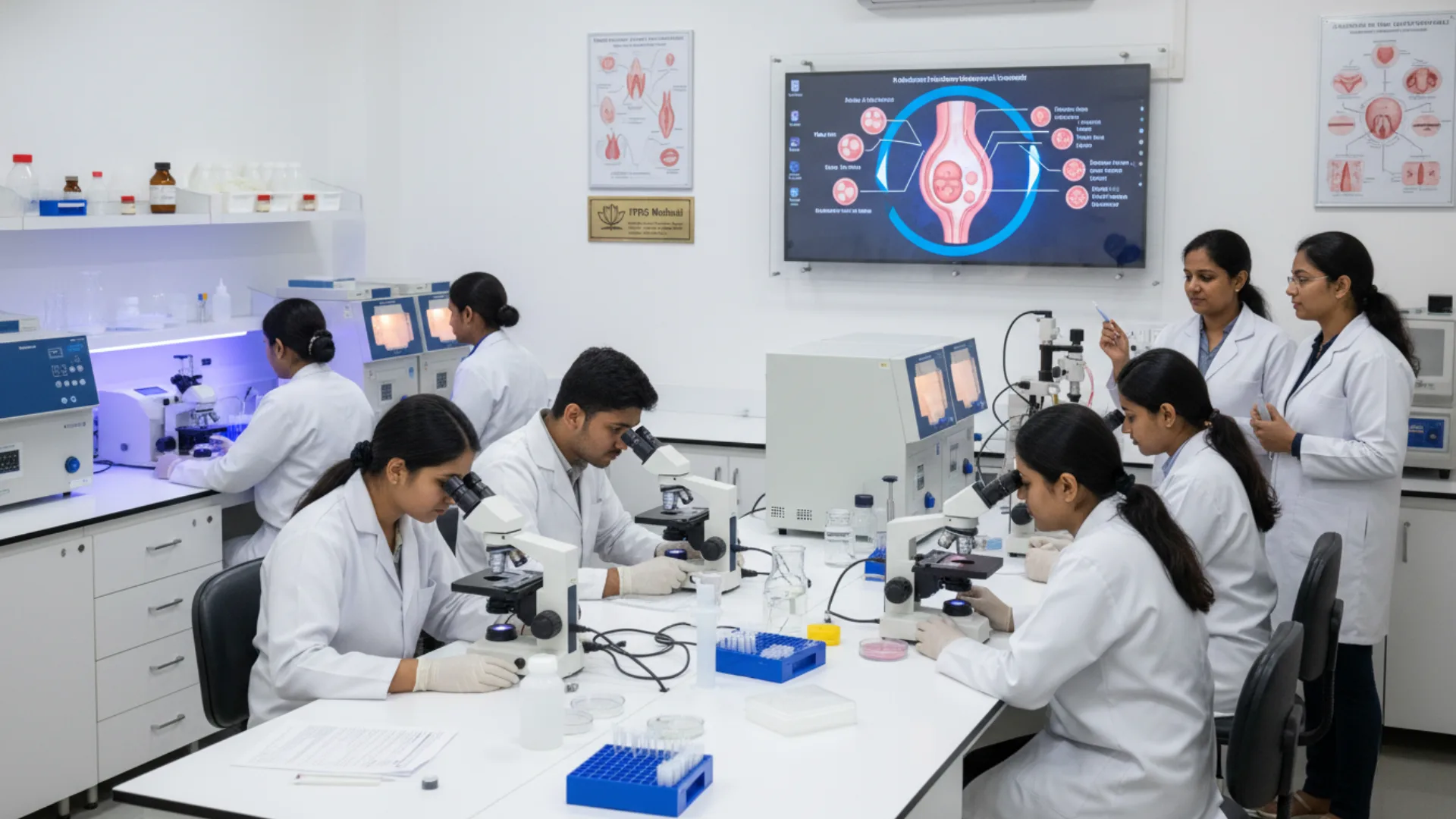
India’s fertility sector has grown significantly over the past decade, with IVF clinics now operating across metropolitan and tier-two cities. The demand for trained ART professionals, clinical embryologists, andrologists, and ART lab specialists, consistently outpaces the supply of formally qualified graduates. For students with a science background after 12th, ART and Clinical Embryology programmes offer a direct, lab-based path into this growing field.
This guide covers what you need to know about ART courses in India, program types, eligibility, costs, career outcomes, and where to study. Whether you’re fresh out of school or looking to specialize after your degree, here’s practical information to help you decide.
Important: An IVF doctor is a gynaecologist or reproductive medicine specialist, they hold MBBS plus MD Obstetrics and Gynaecology, and manage patient treatment plans and egg retrieval procedures. An IVF embryologist or ART specialist works in the laboratory, handling embryos, gametes, and running IVF lab procedures. This course trains lab specialists, not doctors. If you are searching for “how to become an IVF doctor after 12th”, that path requires MBBS and is separate from this programme.
What is Assisted Reproductive Technology?
Assisted Reproductive Technology refers to medical procedures that help couples conceive when natural conception isn’t possible. According to the Indian Council of Medical Research (ICMR), ART success rates in India have improved to 30-35% per cycle, largely due to better training and technology.
The main techniques include:
In Vitro Fertilization (IVF) – Fertilizing eggs with sperm in controlled laboratory conditions. This forms the foundation of most fertility treatments.
Intracytoplasmic Sperm Injection (ICSI) – Injecting a single sperm directly into an egg, used when sperm quality is a concern.
Intrauterine Insemination (IUI) – Placing prepared sperm directly into the uterus during ovulation.
Cryopreservation – Freezing and storing embryos or gametes for future use, increasingly important for fertility preservation.
India now sees over 200,000 IVF cycles annually with more than 20,000 fertility centers nationwide, yet there’s a significant shortage of qualified ART professionals. This supply-demand gap creates strong job security for trained specialists.
As an ART professional, you’ll work in IVF laboratories handling biological material, monitoring embryo development, maintaining quality standards, and collaborating with doctors to give couples the best chance of success.
If you are specifically researching the embryologist career path, what the job involves day-to-day, what the career trajectory looks like, and how this field compares to other health science careers, read our dedicated guide:
How to Become a Clinical Embryologist After 12th →
Types of ART Courses Available
You have several options depending on your current education level and career goals.
BSc in Clinical Embryology & ART
Duration: 3 years | Eligibility: 12th with PCB (50%+ marks)
This undergraduate program gives you foundational training in reproductive biology, laboratory techniques, and patient care. You’ll qualify for entry-level positions as a junior embryologist or ART laboratory technician.
MSc in ART & Clinical Embryology
Duration: 2 years | Eligibility: BSc in Life Sciences/Biotechnology (50%+ marks)
This postgraduate program prepares you for senior positions with deeper training in advanced techniques, quality control, and research methodologies. Graduates work as senior embryologists, IVF specialists, or laboratory managers.
PG Diploma in ART
Duration: 1 year | Eligibility: MBBS/BDS/BVSc/MSc
Designed for medical professionals wanting focused training in assisted reproduction without the time commitment of a full degree.
Quick Comparison
| Course | Duration | Career Level |
|---|---|---|
| BSc ART | 3 years | Entry |
| MSc ART | 2 years | Mid-Senior |
| PG Diploma | 1 year | Specialist |
IVF Course Eligibility – What You Need to Apply
For BSc programs: 12th standard with Physics, Chemistry, Biology and minimum 50% marks (40% for reserved categories).
For MSc programs: Bachelor’s degree in Life Sciences, Biotechnology, Zoology, Microbiology, or related fields with 50% marks. Some institutes conduct entrance exams.
For PG Diploma: Medical degrees (MBBS, BDS, BVSc, BAMS) or MSc in Life Sciences. Work experience preferred but not mandatory.
Beyond academics, this field rewards patience, precision, steady hands for microscopic work, ability to handle pressure, and commitment to continuous learning.
Where to Study: Institute of Translational Health Science (ITHS)
| Campus | University Partner | Programmes Available |
| Chandigarh, Punjab | Rayat Bahra University (RBU) | BSc, MSc, PG Diploma – ART & Clinical Embryology |
| Hoshiarpur, Punjab | Rayat Bahra Professional University (RBPU) | BSc, MSc – ART & Clinical Embryology |
| Shimla, Himachal Pradesh | Bahra University (BU) | BSc, MSc – Clinical Embryology |
| Bhopal, Madhya Pradesh | Scope Global Skills University (SGSU) | BSc, MSc, PG Diploma, PhD – Clinical Embryology & ART |
All four campuses award degrees through their respective UGC-recognised university affiliates. Clinical training takes place in partner hospitals connected to each campus. EMBRYOGENESIS – ITHS’s specialist ART training centre, is based at the Chandigarh campus.
Why ITHS Stands Out
Real Clinical Training – Students train at Bahra Super Specialty Hospital with actual patients under expert supervision. This isn’t observation, you’ll handle cases and perform procedures while in training.
Industry-Standard Facilities – Dedicated ART laboratories with incubators, microscopes, cryopreservation units, and quality control systems matching what you’ll use in your career.
Proven Placement Support – 100% placement assistance backed by career counseling, interview training, and ongoing support after graduation. The placement record speaks for itself.
Significant Scholarships – Merit-based aid covers up to 90% of tuition for qualifying students. Need-based scholarships ensure financial constraints don’t block talented students.
Expert Faculty – Learn from professionals with decades of combined industry experience, including patent holders in reproductive medicine research.
Multidisciplinary Exposure – Exposure to related fields like stem cell technology, cancer biology, and nutrigenetics broadens your perspective and career options.
Location Advantage – Lower living costs compared to metro cities, and closer to home for students from northern states.
Programs at ITHS
Course Fees and Scholarships
BSc programs: (3 years)
MSc programs: (2 years)
PG Diploma: (1 year)
Programme fees vary by campus and are updated each academic year. For the current fee structure at your preferred campus, you can directly contact the ITHS admissions team or submit your enquiry online.
ITHS-SET scholarships of up to 90% on fees are available for eligible students – see the scholarship section below.
Scholarship Opportunities at ITHS:
- Merit-based: Up to 90% tuition waiver
- Need-based: 30-50% fee reduction
- Early application: 10% discount
Graduates typically recover their investment within two years, depending on their career path and opportunities.
Career Opportunities and Salary
Clinical Embryologist – the core IVF lab role, handling embryo culture, grading, fertilisation procedures, and cryopreservation. Entry-level positions are available directly after BSc; senior positions typically require MSc.
Andrologist – specialising in male reproductive health, semen analysis, and sperm preparation techniques. A distinct lab role within ART clinics.
IVF Lab Technologist / ART Lab Technician – supporting embryology lab operations, maintaining equipment, assisting with quality control and documentation.
ART Lab Coordinator / Manager – overseeing lab workflow, staff management, and quality compliance in larger fertility centres. Typically requires MSc and several years of experience.
Research Associate in Reproductive Medicine – research positions at teaching hospitals, pharmaceutical companies, or government research institutions working on fertility-related projects.
Top Employers
Nova IVF Fertility (150+ centers), Cloudnine Fertility, Apollo Fertility, Indira IVF, research institutions, government hospitals, and independent fertility clinics.
International opportunities exist in UAE, Saudi Arabia, Australia, and UK with additional certifications like ESHRE (European Society of Human Reproduction and Embryology).
How to Apply for 2026 Admission
The application process is straightforward. Research which program level suits your education and career goals by exploring clinical embryology programs available.
Gather your documents: academic mark sheets, recent photographs, ID proof, transfer certificates, and category certificates if applicable.
Ready to start? Apply now for ART programs at ITHS or call us for guidance through the process.
Frequently Asked Questions
What is the difference between an IVF doctor and an IVF embryologist?
An IVF doctor manages your treatment, hormones, and procedures. An embryologist works in the lab, handling eggs, sperm, and embryos. Both roles are essential, but the doctor treats you while the embryologist works behind the scenes.
What is the duration of an IVF or ART course?
BSc programs take 3 years (6 semesters), MSc takes 2 years, PG Diploma takes 1 year, and certificate courses run 3-6 months.
Can I study ART after BSc in Zoology or Biotechnology?
Yes, you can pursue MSc in ART with a BSc in Zoology, Biotechnology, Microbiology, or Life Sciences with 50% marks.
Is there demand for ART specialists in India?
Yes, with over 20,000 IVF centers but limited qualified professionals, demand significantly exceeds supply. The sector grows at 22% annually.
Which institute is best for ART in North India?
ITHS in Chandigarh is recognized as the leading institute for ART training in North India, offering UGC-approved programs with hands-on clinical training and 100% placement support.
Can I work internationally after completing an ART course in India?
Yes, with additional certifications from bodies like ESHRE, you can work in UAE, UK, Australia, and USA. Graduates pursuing international roles should verify local registration requirements and any additional certification needed in the destination country.
What’s the difference between Clinical Embryology and ART?
ART is the broader field covering all assisted reproductive techniques. Clinical Embryology specifically focuses on laboratory aspects, embryo handling, development monitoring, and specialized procedures.
Do I need NEET to study ART courses?
No, NEET is only for MBBS and BDS programs. ART courses require 12th with PCB for BSc or a relevant undergraduate degree for MSc.
Start Your ART Career in 2026
Assisted reproductive technology offers meaningful work helping families grow, combining laboratory science with patient care, strong job security in a growing field, and solid financial returns on educational investment.
The Institute of Translational Health Science provides the combination of academic rigor, practical training, and career support that translates to job readiness. UGC-approved programs, hands-on training at Bahra Super Specialty Hospital, and scholarships up to 90% make quality education accessible.
Admissions Open for 2026:
- UGC-recognised
- Hospital-based clinical training
- ITHS-SET scholarships up to 90%