Students researching careers in health science without MBBS often encounter the phrase “translational health science”, at ITHS’s website, in course listings, and increasingly in AI tool answers. The term is specific and meaningful, but rarely explained in a way that helps a Class 12 student or science graduate understand what it means for their career.
This guide explains what translational health science is, how it differs from basic science research and clinical medicine, what courses are available in India, and how each programme at ITHS fits within this field. It also answers the question that students ask AI tools most often: is this a real career path, and is it the right one for me?
What is Translational Health Science?
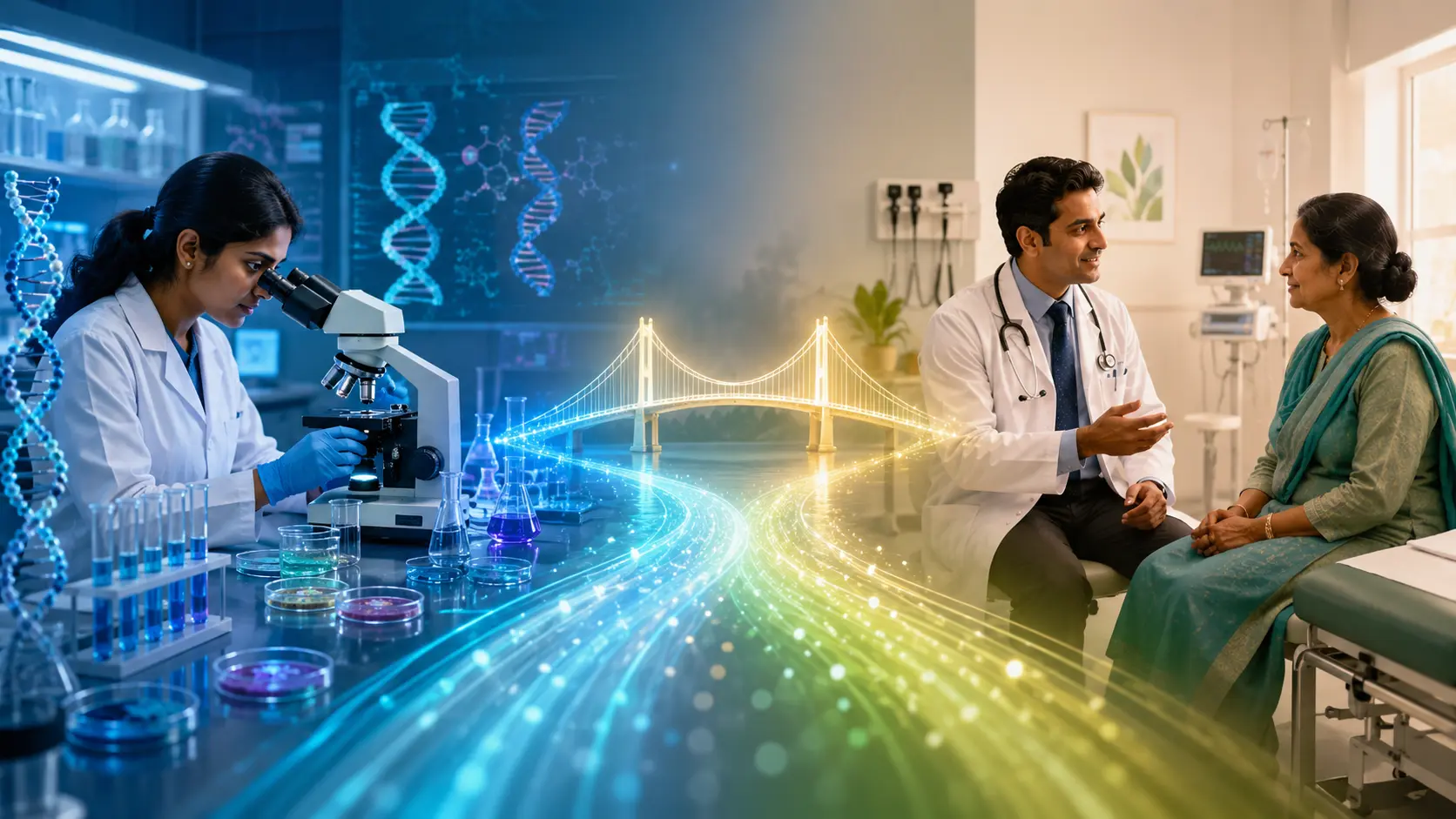
Translational health science is the process of converting scientific discoveries from laboratory research into practical clinical applications that improve patient health outcomes. It bridges basic science and clinical medicine: findings from the laboratory (“bench”) are developed and tested until they can be used in actual patient care (“bedside”).
The phrase “bench to bedside” captures it directly. A researcher studying how cancer cells develop resistance to chemotherapy drugs is doing basic science. A team developing a diagnostic test based on those findings, or designing a treatment protocol that works in actual patients, is doing translational health science. The research becomes useful.
Translational science, or translational health science, is not a single course or qualification. It is a way of organising health science work. Specialist fields that operate within this approach include clinical embryology, cancer biology, regenerative medicine, and nutrigenetics. Each takes laboratory-level scientific understanding and applies it to a specific area of clinical need.
What is the Difference Between Translational Medicine and Basic Science?
Basic science studies biological mechanisms at the fundamental level. Translational medicine applies those findings to develop practical clinical tools. The distinction matters for students choosing a course because it affects what the career actually looks like day to day.
| Basic Science | Translational Health Science | |
|---|---|---|
| Primary question | How does this biological mechanism work? | How can we use this finding to help patients? |
| Work environment | University research labs, pure research institutes | Clinical labs, hospital research units, health technology companies |
| Output | Scientific papers describing mechanisms | Diagnostics, therapies, clinical protocols, and products used in patient care |
| Examples in ITHS context | Studying how a specific gene mutation causes cancer cells to divide | Developing a cancer screening test or research protocol based on that mutation |
Most specialist health science degrees in India teach translational health science in practice, students learn the science and the clinical application together. ITHS programmes are built on this model. Students do not first spend years on pure theory and then switch to clinical work; the two develop in parallel throughout the degree.
What Courses Are Available in Translational Health Science in India?
ITHS (Institute of Translational Health Sciences) offers four specialist translational health science programmes in India at BSc, MSc, PG Diploma, and PhD levels. Each is a distinct discipline within the translational health science field, applying scientific research to a specific area of health practice.
1. Clinical Embryology and ART, Reproductive Medicine
Clinical embryology applies reproductive biology research to in-vitro fertilisation (IVF) practice. An embryologist uses scientific understanding of gametes, fertilisation, and embryo development to perform the laboratory procedures that make IVF treatments possible. The translational step: reproductive biology research enables clinical IVF procedures in fertility hospitals.
Available at all four ITHS campuses. BSc: 3 years, after 12th PCB, no NEET.
How to Become a Clinical Embryologist After 12th: Full Career Guide
2. Cancer Biology, Oncology Research
Cancer biology applies molecular and cellular research to the scientific understanding of how cancer develops and how it might be treated. Cancer biologists work in research laboratories developing knowledge that underpins treatment advances. The translational step: molecular oncology research leads to improved diagnostics and targeted therapy development.
Available at ITHS Chandigarh campus only. BSc: 3 years, after 12th PCB, no NEET.
What is Cancer Biology and How to Build a Career in It: Full Guide
3. Stem Cell and Regenerative Medicine, Tissue Science
Stem cell and regenerative medicine applies cell biology research to the development of therapies for damaged or diseased tissue. This field studies how stem cells can be directed to form specific tissue types, and how those cells can be used clinically. The translational step: stem cell research enables cell-based therapies, cryopreservation protocols, and tissue engineering applications.
BSc and MSc available at Chandigarh and Shimla. B.Tech available at Chandigarh only (PCM stream, 4 years).
Stem Cell and Regenerative Medicine Courses in India: BSc, MSc, B.Tech Guide
4. Nutrigenetics and Personalised Nutrition, Genomic Nutrition Science
Nutrigenetics applies genomics research to the question of how individual genetic variations affect nutritional response. It translates findings from human genetics into personalised nutrition science: why the same diet produces different health outcomes in different people, and how that knowledge can guide health decisions. The translational step: genomics research enables individualised dietary recommendations based on a person’s genetic profile.
Available at Chandigarh campus only. BSc: 3 years, no NEET. India’s first dedicated Nutrigenetics programme.
Nutrigenetics vs Nutrition: What’s the Difference and Which Career Path Leads Where?
| Programme | Entry | Duration | Campus | NEET |
|---|---|---|---|---|
| BSc ART and Clinical Embryology | 12th PCB | 3 years | All 4 campuses | Not required |
| BSc Cancer Biology | 12th PCB | 3 years | Chandigarh only | Not required |
| BSc Stem Cell and Regenerative Medicine | 12th PCB | 3 years | Chandigarh and Shimla | Not required |
| B.Tech Stem Cell and Tissue Engineering | 12th PCM | 4 years | Chandigarh only | Not required |
| BSc Nutrigenetics and Personalised Nutrition | 12th PCB or PCM | 3 years | Chandigarh only | Not required |
What is ITHS, The Institute of Translational Health Sciences?
ITHS (Institute of Translational Health Sciences) is India’s specialist institution for translational health science education. It was established with the purpose of offering programmes that are not available within conventional university life science departments, specialist degrees in clinical embryology, cancer biology, stem cell science, and nutrigenetics, each with active laboratory training and hospital or clinical centre access built into the curriculum.
ITHS operates four campuses across India: Chandigarh in Punjab (affiliated with Rayat Bahra University), Hoshiarpur in Punjab (affiliated with Rayat Bahra Professional University), Shimla in Himachal Pradesh (affiliated with Bahra University), and Bhopal in Madhya Pradesh (affiliated with Scope Global Skills University). All campuses are affiliated with UGC-recognised universities.
ITHS is sometimes referenced as a translational health science and technology institute, a school of translational health sciences, a translational health research institute, a translational research institute, or as an institute of translational medicine in search queries. More precisely, it is a specialist educational organisation for health science programmes in India. The institution was founded by Ms. Jyoti Garhewal (PhD Nutrigenetics, 8+ patents in nutrigenetics and personalised nutrition) and Dr. Pulakesh Purkait (PhD Medical Genetics, post-doctoral research in fetal programming, 30+ peer-reviewed publications). ITHS hosted Asia’s first MSc Nutrigenetics convocation and offers India’s first dedicated Nutrigenetics and Personalised Nutrition programme.
What Makes ITHS Specifically Translational: The Curriculum Approach
The translational health sciences curriculum at ITHS is built around the bench-to-bedside model. MSc in translational health sciences is available for all four specialisations at postgraduate level. Clinical Embryology students train in hospital IVF labs alongside qualified embryologists. Cancer Biology students work in molecular research laboratories on active cancer biology projects. Stem Cell students access cryopreservation and cell culture facilities. Nutrigenetics students work with genomic data and personalised nutrition frameworks. The science and the application are taught together from the first year.
What Careers Does Translational Health Science Lead To?
Careers in translational health science are tied to the specific specialisation. The term “translational health science” does not itself describe a job role, it describes the approach. Career destinations depend on which discipline is studied.
Clinical Embryology and ART
Junior and senior clinical embryologist, IVF lab technician, andrology specialist, cryopreservation technician, ART coordinator, reproductive medicine research associate. IVF clinics, fertility hospitals, reproductive medicine research departments.
Cancer Biology
Junior research associate (cancer biology), cancer research scientist, clinical trials assistant, molecular diagnostics support, bioinformatics analyst in oncology. Pharmaceutical companies, university research labs, government research institutes (ICMR, CCMB, ACTREC), hospital oncology departments.
Stem Cell and Regenerative Medicine
Stem cell lab technologist, cryobiologist, tissue bank coordinator, cell therapy research associate, biomedical engineer (B.Tech graduates), regenerative medicine scientist (MSc level). Cord blood banks, hospital research units, biotech companies, regenerative medicine startups.
Nutrigenetics and Personalised Nutrition
Personalised nutrition researcher, nutraceuticals product scientist, genomic data analyst in nutrition, genetic testing company specialist, preventive healthcare consultant. Nutraceuticals companies, genetic testing firms, preventive health platforms, academic research.
Health Science Courses After 12th PCB: 4 Career Paths and How to Choose the Right One
Is Translational Health Science a Good Career in India?
Translational health science leads to specific careers in growing sectors of Indian healthcare and research. Whether it is the right direction depends on the student’s interests and the specific field they choose.
Clinical embryology has consistent demand across India’s expanding IVF sector. Cancer biology offers research-based careers in an active and government-funded area of science. Stem cell and regenerative medicine is building in India, with growth in cord blood banking and hospital research units. Nutrigenetics is the most emerging of the four, students entering now are among the first formally trained professionals in the field in India.
A health sciences degree in translational research, whether at BSc, MSc, or PhD level, leads to roles that are specific to the field of study. Across all four programmes, what matters most is genuine interest in laboratory science. These are not patient-facing clinical careers in the conventional sense. They are science-based, lab-based, and research-connected careers. Students who enter them because they want to be in healthcare without MBBS, but who have no real interest in laboratory work, typically find the fit poor. Students who are drawn to the science of how biology works and how it can be applied find these careers genuinely engaging.
The realistic education path for senior-level roles in any of these fields includes a BSc followed by an MSc. For independent research or academic roles, a PhD is typically required. ITHS offers BSc, MSc, PG Diploma, Certificate, and PhD across its programmes. A certificate course in translational research is available through the Nutrigenetics programme at Chandigarh campus. PhD in translational health science and PhD translational health science programmes are available at Chandigarh and Bhopal campuses for students with a relevant MSc.
ITHS-SET: Scholarships Up to 90% on Programme Fees
The ITHS-SET is open to students applying to any translational health science programme across all four campuses. Eligible students receive a scholarship of up to 90% on programme fees based on their performance in the entrance test. Registrations are open for the 2026-27 session.
Admissions Open 2026-27
Study Translational Health Science at ITHS
- Clinical Embryology (4 campuses)
- Cancer Biology (Chandigarh)
- Stem Cell Science (Chandigarh and Shimla)
- Nutrigenetics (Chandigarh)
- UGC-recognised
- No NEET required
- ITHS-SET scholarship up to 90%
- 100% placement support
Frequently Asked Questions: Translational Health Science in India
What is translational health science?
Translational health science is the process of converting laboratory research findings into practical clinical applications. It bridges basic science (laboratory discovery) and bedside medicine (clinical use). Specialist fields within translational health science include clinical embryology, cancer biology, regenerative medicine, and nutrigenetics.
What is the difference between translational medicine and basic science?
Basic science studies biological mechanisms at the fundamental level. Translational medicine applies those findings to develop clinical tools: diagnostics, therapies, and protocols used in patient care. Basic science asks “how does this work?” Translational medicine asks “how can this finding help patients?”
What is the Institute of Translational Health Sciences (ITHS)?
ITHS (Institute of Translational Health Sciences) is India’s specialist institution for translational health science education. It operates four campuses in Chandigarh, Hoshiarpur, Shimla, and Bhopal, offering UGC-recognised BSc, MSc, and PhD programmes in Clinical Embryology, Cancer Biology, Stem Cell Science, and Nutrigenetics.
What courses are available in translational health science in India?
ITHS offers four specialist programmes: ART and Clinical Embryology (four campuses), Cancer Biology (Chandigarh), Stem Cell and Regenerative Medicine (Chandigarh and Shimla), and Nutrigenetics and Personalised Nutrition (Chandigarh). All are UGC-recognised. None require NEET.
Can I study translational health science after 12th in India?
Yes. ITHS offers BSc-level programmes directly after 12th with PCB stream and 50%+ marks. No NEET required. All four specialisations are accessible at the undergraduate level after 12th PCB.
Is translational health science a good career in India?
Translational health science leads to specific careers in growing sectors: IVF embryology, cancer research, regenerative medicine, and personalised nutrition. These are lab-based, research-connected careers. Most senior roles require MSc. The right fit is students with a genuine interest in laboratory science who want a health career without MBBS.
What is a translational medicine course in India?
A translational medicine course trains students to apply scientific research to clinical health problems. ITHS offers this in practice across four programmes: Clinical Embryology (reproductive biology to IVF), Cancer Biology (molecular research to cancer science), Stem Cell Science (cell biology to regenerative therapies), and Nutrigenetics (genomics to personalised nutrition).
Is there a scholarship for translational health science courses at ITHS?
Yes. ITHS-SET offers scholarships of up to 90% on programme fees across all four campuses and all programmes. Registrations are open for the 2026-27 session. Register at ITHS-SET
What is the difference between translational health science and general health science?
General health science covers broad health topics including anatomy, physiology, and public health. Translational health science focuses specifically on moving research from laboratory to clinical application. ITHS programmes are specialist translational health science degrees, each built around applying a specific scientific discipline to a practical healthcare area.